Bitcoin
Get started

Account types

Business account

For corporates and treasuries

Personal account

Individual investing made better

Joint account

Invest with your loved one

Parent-child account

Invest together for the future

Platform

Platform

Wallet

Secure your bitcoin

Blockrise App

Real-time insights

Back-up

Never lose access

Broker

Buy and sell bitcoin

Easy Invest

Recurring purchases

Services

Services

Bitcoin-backed loans

Liquidity for your bitcoin

Treasury Management

Bitcoin on the balance sheet

Legacy planning

For the next generation

Asset Management

Managed bitcoin strategy

Secured Lending

Fixed-interest EUR lending

Resources

Resources

Blog

The latest developments

Education

Learn more about bitcoin

Publications

Read our research

About

About Blockrise

Contact

Talk with us

About Blockrise

Meet our team

Fee schedule

Transparent pricing

Careers
0
EN
NL

Log in

EN
NL

Log in

Education

Learn more
about Bitcoin

August 15, 2026

●

  min read

Bitcoin transaction fees explained

A Bitcoin transaction fee is the difference between the inputs a transaction spends and the outputs it creates. Fees are usually compared as a fee rate in satoshis per virtual byte, or sat/vB. The total fee depends on both that rate and the transaction’s virtual size. When block space is scarce, a higher fee rate can make confirmation more likely, but no fixed fee guarantees a confirmation time.

A Bitcoin transaction fee is the difference between the bitcoin a transaction spends and the bitcoin it sends out. Fees help miners decide which transactions to include when block space is limited.

Fees are usually compared in satoshis per virtual byte, written as sat/vB. A satoshi is the smallest unit of bitcoin. A virtual byte is a way to measure the weight of a transaction.

Fee rate and total fee are different

The fee rate is not the total fee. A transaction with a larger virtual size needs a larger total fee to pay the same fee rate.

A simplified calculation is:

total fee = fee rate × virtual size

For example, a transaction that is 200 vB at 10 sat/vB would pay 2,000 satoshis. This is an illustration, not a live fee quote. Actual transaction size depends on the inputs and outputs involved.

Why Bitcoin fees change

Bitcoin blocks have limited space. When more transactions compete for that space, miners can prefer transactions with higher fee rates. A wallet or fee estimator can suggest a rate for a chosen confirmation target, but it cannot guarantee when a transaction will confirm.

Use a current fee estimator when preparing a transaction. An article cannot provide a reliable fixed fee because network conditions change.

If a transaction is waiting

Some transactions can be fee-bumped after broadcast.

Replace-by-fee, or RBF, can replace an earlier transaction with a higher-fee version. Child-pays-for-parent, or CPFP, can use a later dependent transaction to add an incentive for both transactions to be confirmed together.

These methods depend on the wallet, the transaction and network policy. Check what your wallet supports before sending.

Use block space carefully

Modern Bitcoin address formats can reduce transaction weight in many cases. Services that send many payments may also use batching. These approaches can reduce block-space use, but the result depends on the transaction itself.

Before sending bitcoin, check the destination address carefully. Then review the fee rate, total fee and confirmation target separately.

Learn more

August 16, 2026

●

  min read

What is Bitcoin? A beginner’s guide to how it works

Bitcoin is a digital monetary network with public rules that participants can verify; bitcoin is the unit transferred when the required spending conditions are met.

Direct answer

Bitcoin is a digital monetary network with public rules that participants can verify; bitcoin is the unit transferred when the required spending conditions are met.

Bitcoin combines a public transaction ledger with rules that participants can independently verify. The network began operating in 2009. It has a supply rule that limits total issuance to below 21 million bitcoin.[2]

What is Bitcoin?

Bitcoin is a digital monetary network with public rules that participants can verify. The network began operating in 2009 and has a supply rule that limits total issuance to below 21 million bitcoin.[2]

Is Bitcoin a network or an asset?

Bitcoin refers to the network and protocol. bitcoin refers to the units recorded under that system’s rules. A bitcoin can be divided into 100 million satoshis.

How do Bitcoin keys and wallets work?

A private key can authorise spending when the relevant conditions are met. A wallet manages keys, addresses and related information; it does not store bitcoin in the way a physical wallet holds cash.[6]

Do not share a private key or recovery phrase. Key control does not by itself settle every legal ownership question. What is a Bitcoin wallet? explains custody basics.

How do Bitcoin transactions, fees and confirmations work?

A Bitcoin transaction spends existing outputs and creates new outputs. A sender authorises it with the required key material, and the network checks whether it follows the rules before a miner can include it in a block.[3]

Transactions can include fees and may be unconfirmed after broadcast. Further blocks add confirmations; confirmation is a risk-management concept, not an absolute guarantee at a fixed count. Read How to send and receive bitcoin safely for practical transfer safety.

What do Bitcoin nodes do?

Full nodes independently validate transactions and blocks against Bitcoin’s consensus rules. Each node accepts or rejects data according to the rules it runs; nodes do not decide the rules by counting users.[7]

What do Bitcoin miners do?

Miners assemble candidate blocks and use proof of work to compete to add a valid block. They cannot validly create arbitrary bitcoin or spend bitcoin controlled by someone else’s keys, because nodes still validate the rules.

New bitcoin is issued through the block subsidy, which is reduced at 210,000-block intervals. Read How many bitcoins exist? for supply and Bitcoin halving explained for the schedule.

What risks should a beginner understand?

Bitcoin can be volatile. Confirmed transactions can be difficult or impossible to reverse, and loss of private keys or recovery information can prevent access. Fraud, malware, operational mistakes and third-party service failures can also cause loss.

This article is a starting point, not financial, legal or tax advice. Read Bitcoin phishing before acting on an unexpected message.

Frequently asked questions

Is bitcoin stored in a wallet?

No. Bitcoin is recorded on the ledger; a wallet manages keys, addresses and other information used to satisfy spending conditions. Bitcoin Developer Guide: Wallets

Can Bitcoin transactions be reversed?

A confirmed transaction can be difficult or impossible to reverse. The appropriate confirmation policy depends on the payment context and risk. Bitcoin Developer Guide: Transactions

Related reading

  • How many bitcoins exist?
  • Bitcoin halving explained
  • How to send and receive bitcoin safely
  • Bitcoin phishing

Learn more

May 29, 2024

●

  min read

How does the Bitcoin Lightning Network work?

Learn how the Lightning Network enables fast, low-cost bitcoin transactions and what it means for everyday payments.

The Lightning Network is an advanced technology built on top of Bitcoin, serving as a second layer. Introduced in 2016 by Joseph Poon and Thaddeus Dryja, it aims to resolve some inherent issues of the Bitcoin blockchain. In short, the Lightning Network allows users to make transactions off-chain without the need for block confirmation on the blockchain.

Why the Lightning Network?

To understand the necessity of the Lightning Network, it's crucial to know how Bitcoin transactions work. While building and broadcasting transactions is relatively quick, the time-consuming part is the transaction confirmation process. A standard consumer computer can process around 14,000 transactions per second. However, each Bitcoin block, capable of containing approximately 2,000 transactions, is validated roughly every ten minutes. Therefore, processing 14,000 transactions would take about an hour and ten minutes.

This confirmation process is vital because it ensures the integrity and security of transactions, eliminating the need for third-party intermediaries. This verification allows people to trust that the transactions are accurate and legitimate. Shortly put: Bitcoin is a decentralised with an immutable ledger system, which come at a cost.

Challenge of scaling

As Bitcoin adoption grows, more transactions are submitted for verification in the Mempool, leading to higher transaction fees. This increase in fees makes small payments less attractive and practical.

To address these challenges and facilitate faster and cheaper transactions, the Lightning Network was developed as a solution. By creating a second layer on top of the Bitcoin blockchain, the Lightning Network allows for quicker transaction processing without compromising security, making it an essential advancement in the cryptocurrency space.

How the Lightning Network Works

To grasp the functionality of the Lightning Network, we need to explore the process of opening a payment channel, transacting within the channel, and routing payments through the network.

Opening a Channel

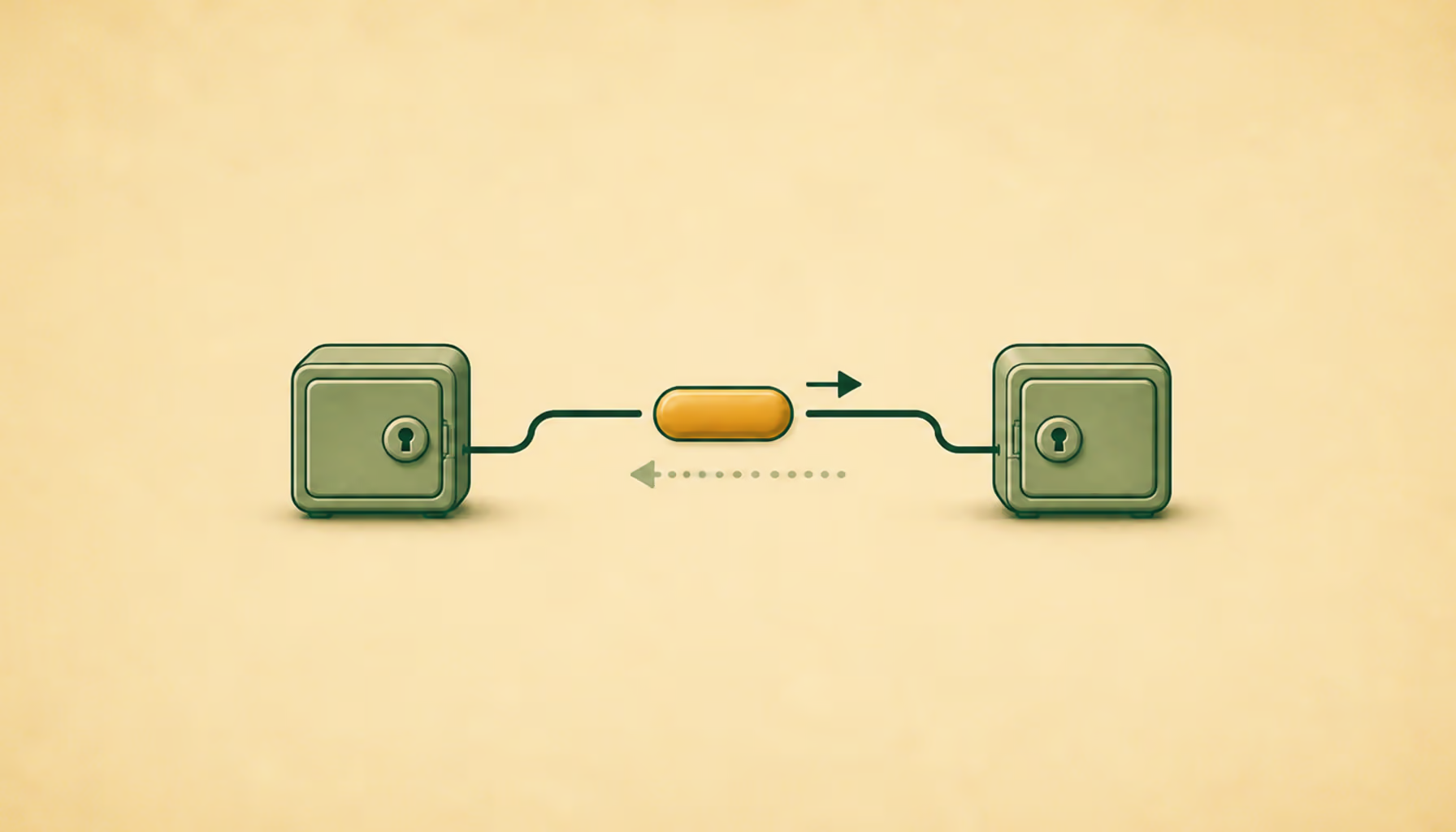
Opening a payment channel between two parties, such as Alice and Bob, is the foundational step in using the Lightning Network. This involves creating a funding transaction on the Bitcoin blockchain, locking a specified amount of Bitcoin into a multi-signature wallet controlled by both parties. Once confirmed, the initial state of the channel reflects the allocation of funds, enabling transactions within the channel. For example, if Alice deposits 1 BTC into the channel, the initial state shows Alice with 1 BTC and Bob with 0 BTC. This setup enables them to begin transacting within the channel.

Transacting Within the Channel

With the channel open, Alice and Bob can perform numerous off-chain transactions quickly and with minimal fees. Each transaction updates the channel's state. For example, if Alice sends 0.1 BTC to Bob, the new state shows Alice with 0.9 BTC and Bob with 0.1 BTC. Cryptographic techniques and revocation keys secure these updates, preventing fraud.

Keeping the Channel Open

Channels can remain open indefinitely, allowing unlimited transactions over time without the need to frequently close and reopen them, saving on fees and improving transaction speed.

Settling Transactions

Alice and Bob can settle their balances at any time by agreeing on the final state and broadcasting it to the Bitcoin blockchain. They might choose to keep the channel open for future transactions, settling on-chain only when necessary.

Routing Payments

The Lightning Network consists of interconnected payment channels, forming a robust network. Payments can be routed through multiple nodes if a direct channel does not exist. For instance, Alice can send payments to Charlie through Bob if Bob has a channel with Charlie. Atomic Multi-Path Payments (AMP) ensure that payments are either fully completed or not at all, preventing partial payments or loss of funds.

Concerns About the Lightning Network

Centralisation

The Lightning Network, aimed at improving Bitcoin's scalability and speed, may lead to centralisation of transaction distribution. If a few large nodes, often run by well-funded entities, control much of the network's liquidity, they become the main transaction routes due to their reliability. This can marginalise smaller nodes, reducing decentralisation. High costs and technical expertise needed for large nodes further exacerbate this issue, creating barriers for smaller players. This concentration of power risks undermining Bitcoin's decentralised nature, making the network vulnerable to censorship, manipulation, and single points of failure.

Fraudulent Channel Closures

The Lightning Network speeds up Bitcoin transactions and cuts costs, but it has risks, including fraudulent channel closures. This happens when someone tries to close a payment channel using an outdated balance that favours them.

For example, if Alice and Bob have a channel and update their balances over time, Alice could cheat by broadcasting an old balance that gives her more Bitcoin than she currently has, effectively stealing from Bob.

The Lightning Network has built-in safeguards to prevent this:

  1. Time-locks: When a channel is closed, there's a waiting period allowing the other party to contest if they spot fraud.
  2. Revocation Keys: Each update invalidates the previous state with a key. If someone tries to use an old state, the other party can use the key to reclaim funds.

How to Access the Lightning Network

To use the Lightning Network, set up a Lightning wallet (mobile, desktop, or hardware), and fund it with Bitcoin from your regular wallet. Open a payment channel by committing Bitcoin. Once the channel is established, you can conduct transactions within the network. The wallet will automatically route payments if you don't have a direct channel with the recipient.

The Lightning Network enhances Bitcoin's scalability and transaction efficiency through off-chain transactions. It offers benefits like faster and cheaper transactions but also poses challenges such as potential centralisation and fraudulent channel closures. Understanding how to use and safeguard the network helps maximise its advantages and mitigate risks, contributing to a more robust and decentralised Bitcoin ecosystem.
Learn more

August 15, 2026

Price of bitcoin on 1 January 2026

Learn more

August 15, 2026

Bitcoin vs a Bitcoin ETF

Learn more

August 16, 2026

How many bitcoins exist? Supply, issuance and lost coins

Learn more

August 16, 2026

Bitcoin halving explained: mechanics, history and 2028

Learn more

January 17, 2024

What is a Bitcoin faucet?

Learn more

August 15, 2026

Bitcoin tax in the Netherlands

Learn more

April 10, 2024

How does the dollar cost averaging strategy work?

Learn more

August 15, 2026

Bitcoin inheritance planning: access, keys and legal steps

Learn more

March 20, 2024

What is double-spending?

Learn more

May 27, 2024

What is a Bitcoin node?

Learn more

August 16, 2026

How to send and receive bitcoin safely

Learn more

August 16, 2026

Bitcoin phishing: spot scams and respond after a click

Learn more

Previous

1

Next
2 / 3

No items found

Clear all filters

Mobile app

Take control of your Bitcoin. Get started with Blockrise today.

Blockrise is the regulated platform to buy, hold and verify your bitcoin on-chain, semi-custodial wallet. MiCAR-licensed. No compromises.

Get started

+31 10 848 17 41
support@blockrise.com

Get started

Business accountPersonal accountJoint accountParent-child account

Services

Asset ManagementBitcoin-backed loansSecured LendingLegacy planningTreasury Management

Platform

WalletBrokerEasy InvestBlockrise AppBack-upBlockrise Status

Resources

BitcoinAbout usBrandFee scheduleContactBlogEducationPublicationsCareers ↗

Legal

Privacy policyCookie statementBitcoin disclosuresRisk disclosureConflict of interest disclosureSummary of order execution policyComplaints procedure
Copyright © 2025 Blockrise | All Rights Reserved

Blockrise is a Bitcoin only platform based in Rotterdam, the Netherlands. Founded in 2017. We offer custody, wealth management, brokerage, Bitcoin backed loans, treasury services, secured lending, and estate planning, all focused exclusively on Bitcoin. Blockrise Capital B.V. holds a MiCAR licence (number 41000029) issued by the Dutch Authority for the Financial Markets (AFM).

Everything about Secured Lending

Download the brochure and learn more about our offering.

Blockrise needs the contact information you provide to us to contact you about our products and services. You may unsubscribe from these communications at any time. For information on how to unsubscribe, as well as our privacy practices and commitment to protecting your privacy, please review our Privacy Policy.