Blog
Discover everything
Blockrise has to offer.

BIP-110 split from Bitcoin. What happened, and what comes next?
What happened during the BIP-110 chain split, why the minority branch stalled after two blocks and what it shows about Bitcoin consensus.
On Saturday, a small group of nodes enforcing BIP-110 stopped following the same blockchain as the rest of the Bitcoin network. Their alternative chain produced two blocks before stalling. Bitcoin continued processing transactions and producing blocks normally.
This event offered a useful view of how Bitcoin handles contested rule changes. Anyone can choose which software to run, but new rules only become part of Bitcoin when users, miners and economically relevant services converge on them.
What BIP-110 proposed
BIP-110, formally called the Reduced Data Temporary Softfork, proposed a temporary change to Bitcoin's consensus rules. For about one year, it would restrict several ways of placing larger amounts of arbitrary data inside Bitcoin transactions.
Supporters argued that images, text and other non-financial data impose permanent storage costs on node operators and compete with payments for block space. Critics objected to changing Bitcoin's consensus rules to decide which fee-paying transactions count as acceptable. They also warned that BIP-110 affected more than images or inscriptions. Its seven rules restricted several script and witness constructions, including features that may support future protocol development.
The proposal sought 55% miner signalling. It also contained a mandatory-signalling fallback. From block 961,632, nodes enforcing BIP-110 would reject any block that did not signal support, even if the rest of the network considered that block valid.
How the chains separated
The voluntary threshold was not reached. Only about 2.53% of blocks in the final period signalled for BIP-110.
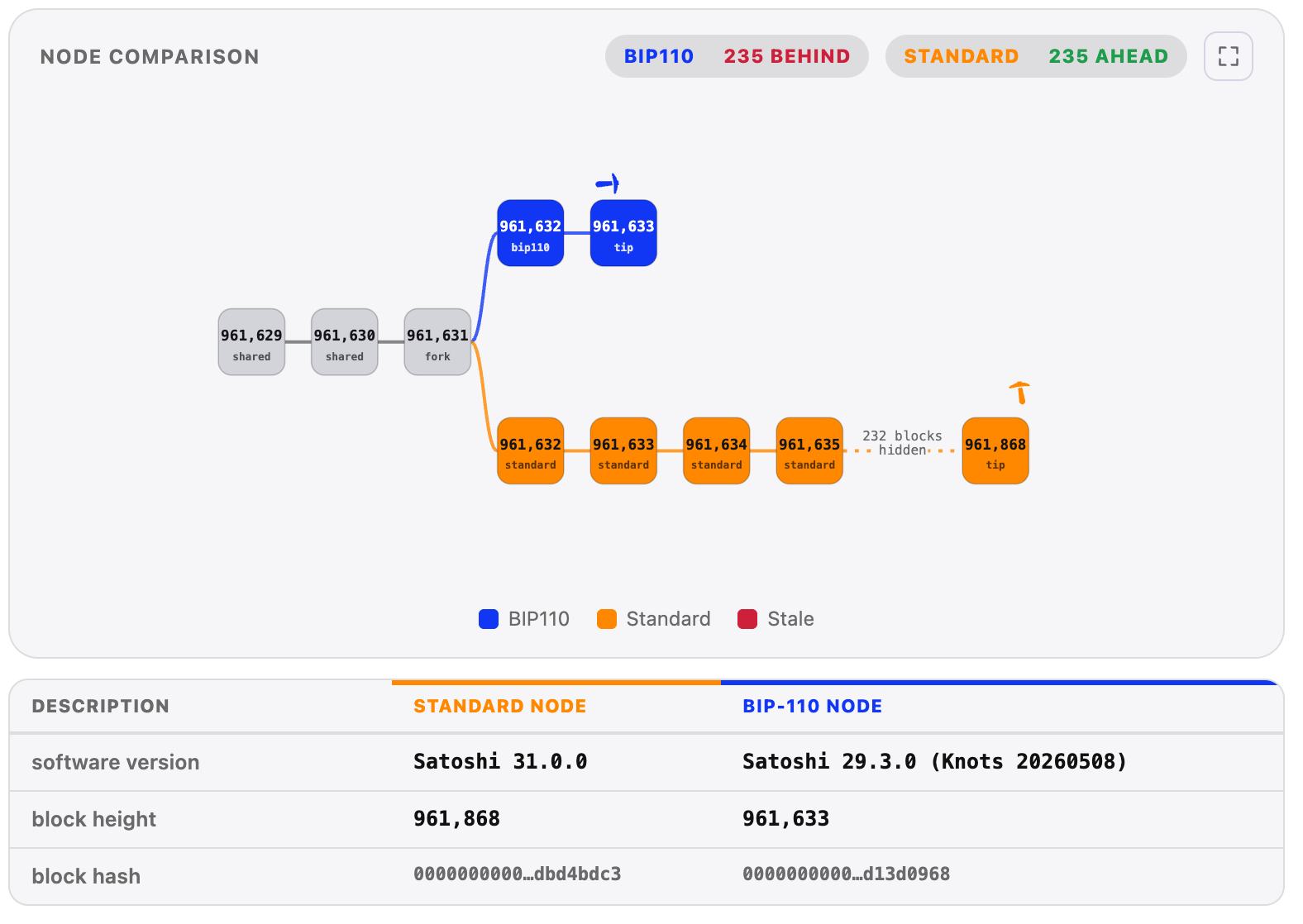
At block 961,632 on Saturday, AntPool mined a block without the BIP-110 signal. Standard Bitcoin nodes accepted it. BIP-110 nodes rejected it and remained at the previous block.
A miner using OCEAN then produced an alternative signalling block at height 961,632, followed by one more at height 961,633. The main Bitcoin chain accumulated more computing work and pulled ahead. BIP-110 nodes could not follow it because they considered its first non-signalling block invalid.
This was a genuine chain split: two groups of nodes held incompatible views of the valid blockchain. It did not create two equally supported versions of Bitcoin. One branch retained almost all mining activity and the network's existing economic infrastructure. The other produced two blocks.
Early on Sunday, Roughnecks, the mining group associated with the two BIP-110 blocks, announced that it had stopped mining and advised others mining the branch under the current algorithm to stop.
Why the minority chain stalled
Bitcoin adjusts mining difficulty every 2,016 blocks so that a new block arrives roughly every ten minutes. A branch that splits from Bitcoin inherits the same difficulty at the moment of separation.
With little computing power, the BIP-110 miners faced blocks calibrated for the much larger Bitcoin network. Blocks arrived slowly, yet the branch still needed to produce 2,016 of them before it could reduce the difficulty.
At 11:28 CEST on 10 August, OrangeSurf's live monitor showed the standard chain at block 961,857 and the BIP-110 branch at 961,633, a gap of 224 blocks. It estimated that Bitcoin would reach its next difficulty adjustment in 12 days, while the minority branch would need approximately 4.3 years at its observed pace.
That estimate will change if miners join or leave. It shows why the branch cannot progress through its activation schedule under current conditions.
What the split means for Bitcoin
A technical chain split is not automatically a network crisis. The practical outcome depends on which chain attracts sustained mining, users, wallets, exchanges, businesses and liquidity.
The episode also showed why node counts or public declarations do not establish consensus on their own. Miners do not unilaterally decide Bitcoin's rules, but computing power determines which valid chain accumulates work. Users and businesses determine which rules and which asset they recognise. A contested change needs these groups to coordinate.
For users who remained on the main Bitcoin chain, the network continued operating. The operational and double-spend risks were concentrated on the stalled branch and among anyone attempting to transact across both histories without replay protection.
The result does not settle the dispute about arbitrary data. Some Bitcoin users will continue to argue that the fee market should determine how block space is used. Others will continue to view permanent non-financial data as an avoidable burden.
What happens next
BIP-110's reduced-data rules did not activate on the main Bitcoin chain. Its minority branch still exists as a separate history, but it cannot advance through the mandatory-signalling period at a practical pace without renewed mining support.
Luke Dashjr indicated on X that supporters do not consider the effort over. On 9 August, he said there was an ongoing discussion about how to move forward. Several hours later, he wrote that a proof-of-work change would follow if sufficient mining support did not return. This is not yet a finished or broadly accepted proposal. Changing Bitcoin's proof-of-work algorithm would be a separate hard fork requiring new software, coordination and economic support.
Future proposals addressing arbitrary data will face the same test: rigorous technical review and enough support from users, miners and economic services to change Bitcoin's shared rules without leaving supporters on an isolated chain.
Saturday did not settle how Bitcoin should treat arbitrary data. It showed how difficult it is to change Bitcoin's rules without broad consent.
Learn more


Blockrise applies Bitcoin ethos to its asset management offering
From 1 July 2026, Blockrise will remove the performance fee on Fundamentals, following last month’s move to cut custody fees to zero and further aligning its asset management offering with long-term Bitcoin ownership.
Rotterdam, 24 June 2026 - Blockrise today announced that it will remove the performance fee from its Fundamentals strategy. The new fee schedule takes effect on 1 July 2026 and brings the proposition further in line with the Bitcoin ethos of long-term value retention.
The change matters for clients and investors with a long time horizon. A performance fee takes a share of returns when a strategy performs well, which is also when compounding matters most. Under the new model, Blockrise earns from managing assets and providing services, not from participating in the upside.
The decision follows Blockrise's recent move to set custody fees to zero, making secure Bitcoin custody available without an ongoing custody charge. Together, both changes reflect the same principle: long-term Bitcoin exposure works best when friction stays low and incentives stay clear.
"We want our proposition to reflect what Bitcoin investors value: clarity, alignment, and long-term exposure," said Jos Lazet, CEO of Blockrise. "Removing the performance fee is the logical next step after reducing the custody fee to zero. Both decisions come from the same conviction.”
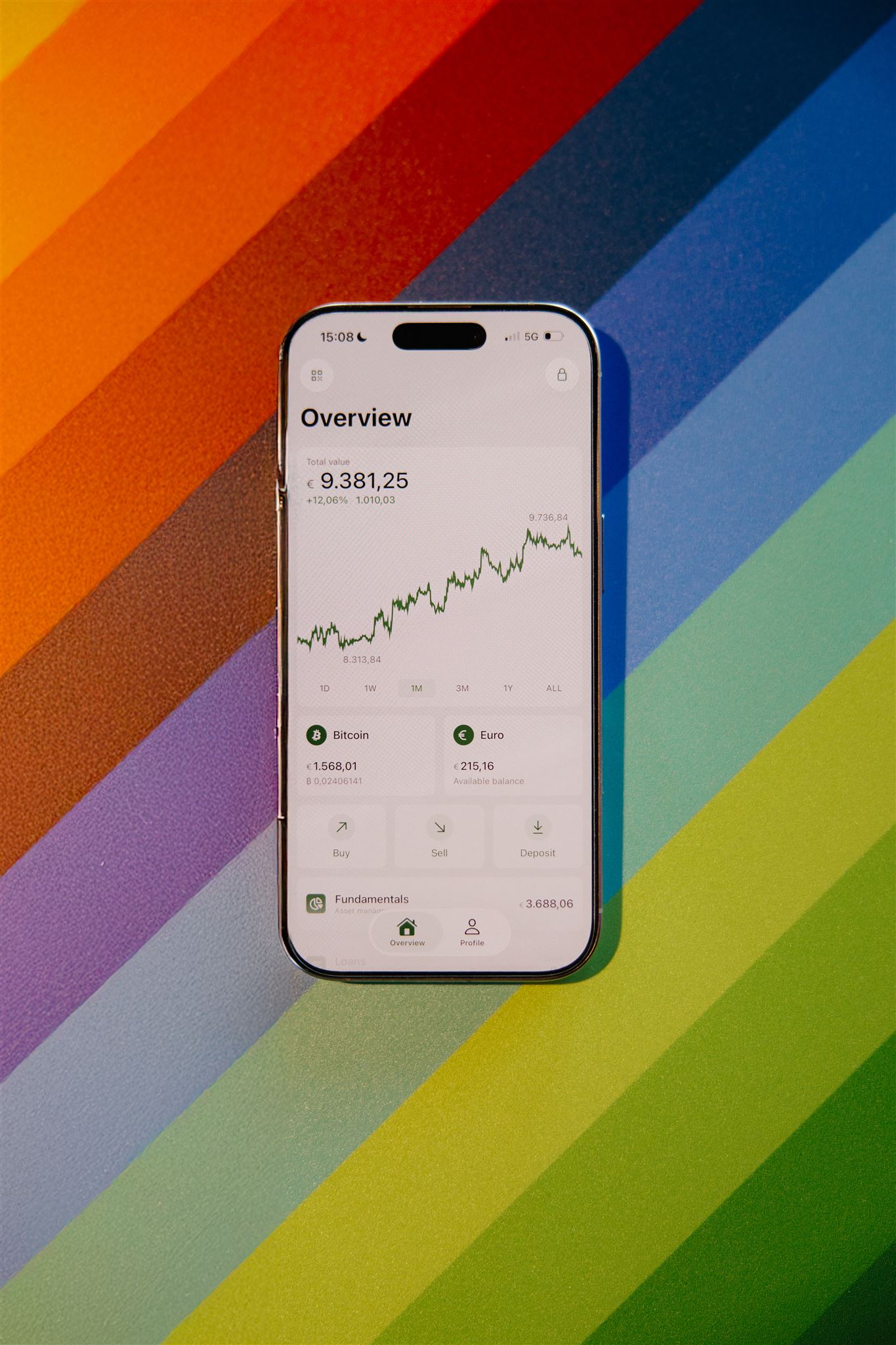
Fundamentals is a systematic, rule-based strategy that adjusts exposure between Bitcoin and euro using a quantitative model. It is built for people who want long-term exposure to Bitcoin with managed downside and lower volatility, while maintaining control over their own bitcoin. The strategy creates value through the model and risk management, not through frequent trading.
The latest fee schedule is available on the Blockrise website.
About Blockrise
Blockrise is a Bitcoin-only platform based in Rotterdam, with a mission to make bitcoin accessible without compromising what makes it valuable. Founded in 2017, it offers trading and asset management. Clients use a hybrid custody model designed to preserve control and verifiability over their bitcoin.
Blockrise serves individuals and businesses across Europe. Visit www.blockrise.com
For interview requests and more information:
Jos Lazet, Founder and CEO Blockrise j.lazet@blockrise.com +31 10 848 1741
Learn more

Publications

16 Jun
What MiCAR means for your Bitcoin



Press Release
Updates
29 Apr
bunq and Blockrise partner to provide users with secure access to Bitcoin services
Featured
Releases
Publications
12 Mar
Case Study: Building cryptographic control from day one: Blockrise and Securosys
No items found

Take control of your Bitcoin. Get started with Blockrise today.
Get started